
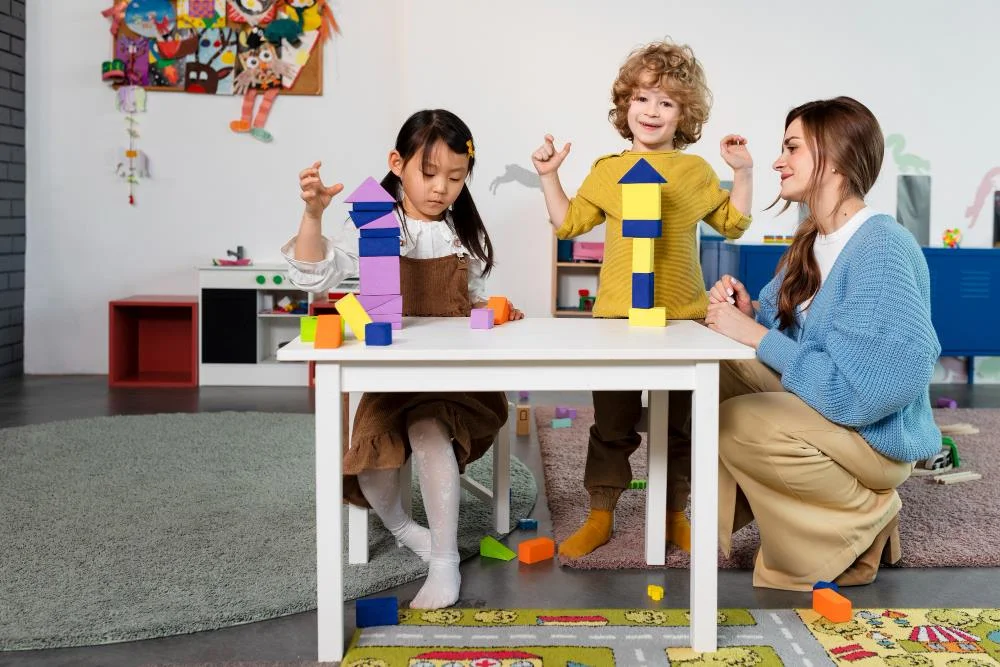
Young children learn best through doing, and when it comes to daycare, the best programs offer a variety of engaging, developmentally appropriate activities that support learning through play. At Rainbow Childhood Education Center, we believe that the most effective daycare activities for preschoolers strike a balance between fun and purpose, movement and focus, and independence and collaboration.
From motor skill development to emotional growth, the right mix of daily activities can help preschoolers build a strong foundation for school and life. Below, we break down the most valuable categories of daycare activities and how each contributes to early childhood development.
1. Creative Indoor Play: Building Skills Through Art, Pretend, and Hands-On Exploration
Indoor play isn’t just about staying busy; it’s about creating structured opportunities for growth in a safe, inspiring space. Through art and imaginative play, preschoolers develop fine motor coordination, spatial reasoning, and self-expression.
Art and craft stations, for example, introduce children to color mixing, texture exploration, and basic tool use (like glue sticks and child-safe scissors). These activities are not only fun—they help develop hand strength and control, both essential for future writing and self-care skills. At Rainbow Childhood, we rotate materials frequently to spark fresh interest and encourage creative risk-taking.
Pretend play also plays a powerful role in early development. By acting out real-life roles like “doctor” or “chef,” children experiment with social roles, language, and sequencing. Research supports that dramatic play helps preschoolers develop narrative skills, problem-solving abilities, and emotional regulation (Parents.com, 2023). It’s through pretend that children make sense of the world.
Here are a few structured indoor activities we often use:
- Story-inspired dress-up days
- Build-a-town with cardboard blocks and figurines
- Color matching with clothespins and paint swatches
These moments are more than play; they are stepping stones to independence, communication, and creativity.
2. Gross Motor Fun: Physical Development Through Movement and Play
Preschoolers are naturally active, and their bodies need frequent movement to grow strong and develop coordination. Gross motor activities are essential in daycare programs, as they help children build core strength, improve balance, and release energy in a healthy, structured way.
One of our favorite indoor games is balloon keep-up, where children work together to keep a balloon from hitting the ground. It’s simple but incredibly effective in promoting teamwork, spatial awareness, and reflex control. According to Parents.com, games like these also teach patience and focus, skills often undervalued in physical play.
Obstacle courses are another staple in our program. Using cones, tunnels, hula hoops, or pillows, we set up creative paths that challenge children to crawl, climb, balance, and jump. These tasks improve agility, encourage problem-solving, and build resilience when kids don’t succeed the first time.
Finally, activities like dance and freeze games allow children to combine music, listening skills, and movement. With cues like “freeze when the music stops,” kids learn impulse control, rhythm, and the ability to quickly adapt.
Key benefits of gross motor activities:
- Enhance coordination and balance
- Strengthen large muscle groups
- Improve self-regulation through physical routines
Daily movement keeps young learners physically healthy and mentally alert, and sets the tone for productive, joyful learning.
3. Outdoor Learning: Nature, Discovery, and Free Exploration
Taking children outside transforms a routine day into an adventure. Outdoor activities not only strengthen gross motor development but also allow preschoolers to connect with nature, observe seasonal changes, and explore in a way that engages all five senses.
One effective outdoor activity is a nature scavenger hunt. Children search for specific items like leaves, rocks, or insects using simple checklists with pictures or words. This task builds observation skills, vocabulary, and categorization. Outdoor educator blogs (e.g., Klay Preschool and Brightwheel) highlight how activities like these also build patience and encourage scientific thinking.
We also engage our preschoolers in garden-based learning. Children plant seeds, water soil, and watch sprouts turn into vegetables or flowers. Not only does this process teach basic biology, but it also nurtures responsibility and patience. According to a study on garden-based learning (Ozer, 2007), these experiences can even improve children’s attitudes toward healthy eating.
In more natural spaces, we introduce loose parts play, where children use branches, rocks, and leaves to build forts or imaginative structures. These unstructured moments encourage problem-solving, storytelling, and collaboration, all through open-ended outdoor play.
4. Sensory Stations: Encouraging Learning Through Touch, Smell, and Sound
Sensory activities are a cornerstone of early childhood education because they help children process the world around them. These experiences engage children in calming, focused tasks while supporting language development, motor skills, and emotional self-regulation.
A popular option is the sand and water table, where children scoop, pour, measure, and stir. These motions refine hand-eye coordination and introduce early math concepts such as volume, weight, and comparison. It’s also a soothing activity, perfect for children who need a sensory break.
We also create sensory discovery bins, filling trays with materials like dry rice, cotton balls, beads, or fabric scraps. Children dig through these textures to find small toys or letters. This not only hones tactile processing, but also builds vocabulary and attention to detail.
Lastly, our teachers sometimes create scented learning stations, using materials like cinnamon, lavender, or lemon-scented play dough. These experiences reinforce sensory associations while introducing children to the concept of categorization.
Sensory play supports:
- Emotional regulation through calming repetition
- Cognitive development through experimentation
- Language growth by describing sensory experiences
5. Music, Movement, and Language Development
Music activities are more than entertainment; they’re powerful tools for enhancing memory, language, and motor skills. Songs with movement and rhythm engage both sides of the brain, making them ideal for building coordination and communication.
We frequently use action songs like “If You’re Happy and You Know It” or “The Wheels on the Bus.” These songs pair movement with language, helping preschoolers understand cause and effect, sequence, and following directions.
In our rhythm and instrument time, we offer shakers, tambourines, and hand drums. Children experiment with tempo, beat, and volume, which improves auditory discrimination and fine motor control.
For language development, we often follow up read-aloud stories with dramatization. Acting out parts of the story helps children understand plot, recall details, and express ideas. These activities support pre-reading skills and confidence in verbal communication.
Final Thoughts
At Rainbow Childhood Education Center, we believe that the best daycare activities for preschoolers combine fun with learning and structure with freedom. Through hands-on play, movement, music, sensory exploration, and social collaboration, we help children thrive, academically, emotionally, and physically.
Want to see our activities in action? Visit rainbowchildhood.com to schedule a tour or speak with one of our early learning specialists.
Frequently Asked Questions
Why are daycare activities important for preschoolers?
Daycare activities help children develop motor skills, creativity, social awareness, and emotional regulation through play.
What types of indoor activities support preschool learning?
Art, crafts, and pretend play encourage fine motor skills, imagination, problem‑solving, and self‑expression.
How do gross motor activities benefit young children?
Games like obstacle courses, dance, and balloon play build strength, coordination, balance, and teamwork.
What role do sensory stations play in early learning?
Sensory play enhances language, emotional regulation, and cognitive growth by engaging touch, smell, and sound.
How does music support preschool development?
Songs, rhythm games, and instruments improve memory, language skills, listening, and motor coordination.