
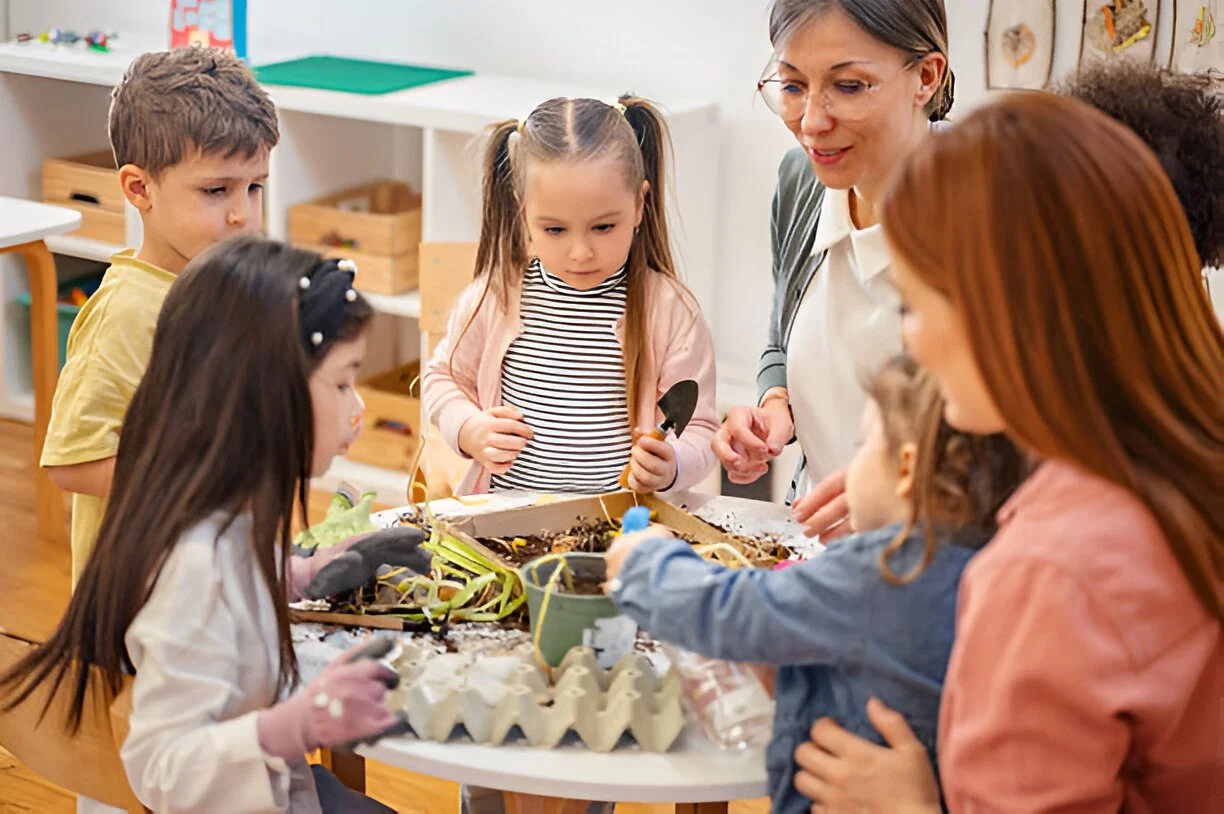
In early childhood education, every experience is a building block for future learning. At Rainbow Childhood Education Center, we understand the importance of combining fun with foundational skills to promote healthy development in preschool-aged children. That’s why we integrate STEM activities for preschoolers into our curriculum, ensuring each child is engaged and building essential skills for the future.
STEM, an acronym for Science, Technology, Engineering, and Math, is no longer reserved for middle or high school classrooms. Introducing preschoolers to STEM concepts through hands-on, play-based learning helps nurture curiosity, foster creativity, and develop critical thinking from an early age. In this article, we’ll explore why STEM matters in preschool and share practical, creative activities you can do at home or in a classroom setting.
Why STEM Activities Matter in Preschool
While it may seem early to begin teaching STEM to children between the ages of 3 and 5, research consistently shows that early experiences with problem-solving, logical thinking, and exploration set the stage for long-term academic success. STEM activities for preschoolers help build core developmental skills, including:
1. Critical Thinking and Problem-Solving
STEM activities encourage children to ask questions, test ideas, and figure out how things work. For example, they try a different strategy when a child builds a block tower and it falls over. This process strengthens their ability to think critically and adapt.
2. Fine and Gross Motor Development
Whether measuring with rulers, pouring liquids, or stacking objects, STEM activities often involve hands-on manipulation of materials. This strengthens fine motor skills, essential for writing, tying shoes, or scissors.
3. Language and Communication Skills
As children engage in STEM play, they naturally describe their actions, ask questions, and share observations. This builds vocabulary and encourages meaningful dialogue, a core part of early literacy development.
4. Confidence and Independence
Solving simple problems or completing a task independently helps children feel capable and proud. They develop a sense of ownership and confidence in their abilities when they experiment and see results from their actions.
5. Collaboration and Social Development
Many STEM preschool activities involve group work, whether building a structure or comparing results from a science experiment. These interactions help children learn cooperation, patience, and communication.
At Rainbow Childhood, these skills are just as important as academic knowledge. By offering STEM-rich environments, we allow preschoolers to explore and learn naturally.
Creative STEM Activities for Preschoolers: Ideas to Try
You don’t need expensive tools or elaborate kits to bring STEM into your child’s day. Most STEM activities for preschoolers can be done using simple, everyday materials. Here are six of our favorite ideas, tested and loved by our educators.
1. Sink or Float?
Fill a large bowl or container with water and gather household objects like plastic spoons, toy cars, rubber bands, coins, and leaves. Ask your child to guess which items will float and which will sink. Then, test each item one by one and talk about the results.
STEM focus: Teaches basic scientific principles like density and buoyancy. It also introduces the scientific method, making predictions, testing, and observing outcomes.
Extension idea: Create a simple chart to record results, reinforcing math and early graphing skills.
2. Marshmallow and Toothpick Towers
Give your preschooler mini marshmallows and toothpicks and challenge them to build the tallest structure they can. Allow time to test different shapes and combinations.
STEM focus: This introduces basic engineering concepts like balance, support, and design. Children learn how shapes and angles affect stability.
Extension idea: Encourage them to draw their design before building to integrate early planning and architectural thinking.
3. Color Mixing with Water
Using three clear cups filled with water and food coloring (red, yellow, and blue), give your child an eye dropper and empty cups. Let them mix colors to see what new colors they can create.
STEM focus: Teaches early chemistry concepts such as cause and effect and introduces the idea of experimentation and result tracking.
Extension idea: Add different materials such as salt, vinegar, or oil to observe how substances interact with colored water.
4. Ramp Races
Using cardboard, create simple ramps of varying lengths and angles. Let your child race small cars or balls down each ramp. Ask questions like, “Which ramp makes the car go faster?” or “What happens if we make the ramp steeper?”
STEM focus: Combines engineering with basic physics concepts such as gravity, inclination, and motion.
Extension idea: Use a stopwatch or visual markers to measure time or distance traveled. This introduces basic data collection and measurement.
5. Nature Sorting and Counting
During a walk outdoors, invite your child to collect natural objects like stones, sticks, and leaves. Back inside, sort the items by shape, size, color, or type, and count how many.
STEM focus: Helps children develop categorization skills, early math abilities like counting and comparing, and observational skills.
Extension idea: Create a simple tally sheet to track how many items were collected, integrating math and early chart-making.
6. Magnetic and Non-Magnetic Discovery
Provide a small magnet and a mix of objects, paper clips, plastic toys, coins, buttons, and let your child explore which items are magnetic. Encourage them to sort objects into “magnetic” and “non-magnetic” groups.
STEM focus: Teaches about magnetism, material properties, and classification.
Extension idea: Turn it into a guessing game by having your child predict the result before testing each item.
Bringing STEM into Everyday Moments
One of the best parts of integrating STEM activities for preschoolers is how easily they fit into everyday routines. At Rainbow Childhood, we encourage families to make use of these ideas at home:
- In the kitchen: Measuring ingredients, observing how food changes when cooked, and organizing utensils by size.
- During bath time: Exploring sinking and floating toys, pouring water into containers, and experimenting with temperature.
- In the garden: Observing insects, counting petals, and planting seeds to learn about growth and biology.
Children are naturally curious; nearly any moment can become an opportunity for exploration and learning when guided intentionally.
Preschool STEM Activity Planner: Skills, Materials, and Best Use
Use this quick planner to choose STEM activities based on your child’s age, interest, and learning goal. Most of these activities can be done at home or in a preschool classroom with simple materials.
| Activity | Main STEM Area | Simple Materials | Best For | Skill Built |
| Sink or Float | Science | Water bin, safe household objects | Ages 3–5 | Prediction, observation, comparison |
| Marshmallow and Toothpick Towers | Engineering | Marshmallows, toothpicks, tray | Ages 4–5 with supervision | Balance, structure, problem-solving |
| Color Mixing | Science | Clear cups, water, food coloring, droppers | Ages 3–5 | Cause and effect, color recognition |
| Ramp Races | Engineering and Science | Cardboard, toy cars, balls | Ages 3–5 | Motion, speed, testing |
| Nature Sorting | Math and Science | Leaves, stones, sticks, containers | Ages 2.5–5 | Sorting, counting, classification |
| Magnet Discovery | Science | Child-safe magnet, large objects | Ages 4–5 with close supervision | Material properties, observation |
More Easy STEM Activities for Preschoolers by Learning Goal
- Weather Watch Chart
- Build a Bridge Challenge
- Seed Sprout Observation
- Shadow Shape Play
- Ice Melt Rescue
- Pattern Walk
- Texture Sorting
- Simple Coding Path Game
How Rainbow Childhood Supports Early STEM Learning
At Rainbow Childhood Education Center, our curriculum is rooted in play-based learning that’s intentional, inclusive, and engaging. We believe STEM education should start early, and our approach reflects that commitment.
Through structured and unstructured play, we provide children with the tools to:
- Ask meaningful questions and explore answers independently.
- Use real-world materials to create, build, and solve problems.
- Develop confidence through experimentation and success.
- Learn through collaboration and guided instruction.
Our educators are trained to recognize teachable moments and introduce STEM concepts naturally during daily activities.
Final Thoughts
Introducing STEM activities for preschoolers is one of the most effective ways to build a strong foundation for future academic and life success. By combining curiosity with hands-on learning, children gain skills in science, technology, engineering, and math and develop confidence, communication, and resilience. Whether at home or in a classroom, the goal isn’t to “teach” in the traditional sense; it’s to inspire exploration, foster joy, and encourage thinking.
If you’re looking for a nurturing environment where your child can thrive through engaging, age-appropriate STEM activities, we invite you to learn more about Rainbow Childhood Education Center. Our team is passionate about helping children grow through meaningful, discovery-driven learning. Visit rainbowchildhood.com to schedule a tour or learn more about our programs.
Frequently Asked Questions (FAQs)
What is a simple STEM activity for preschoolers?
A simple STEM activity can be testing which objects sink or float in water. Children make a prediction, test it, and talk about what happened.
How often should preschoolers do STEM activities?
Preschoolers can explore STEM daily through short activities. Counting toys, sorting objects, building blocks, or observing weather all support early STEM learning.
Do STEM activities for preschoolers need screens or technology?
No, preschool STEM does not need screens. Simple tools like ramps, cups, magnifying glasses, blocks, and sorting games can teach early technology and problem-solving skills.
Are STEM activities safe for 3 to 5 year olds?
Yes! when the materials are age-appropriate and supervised by an adult. Activities with water, magnets, scissors, or small parts need close guidance.
What skills do preschool STEM activities build?
STEM activities build observation, counting, sorting, fine motor skills, language, patience, and problem-solving. These skills support school readiness through hands-on play.
How can parents support STEM learning at home?
Parents can support STEM by asking questions during everyday play. Cooking, bath time, nature walks, and clean-up can become simple learning moments.