
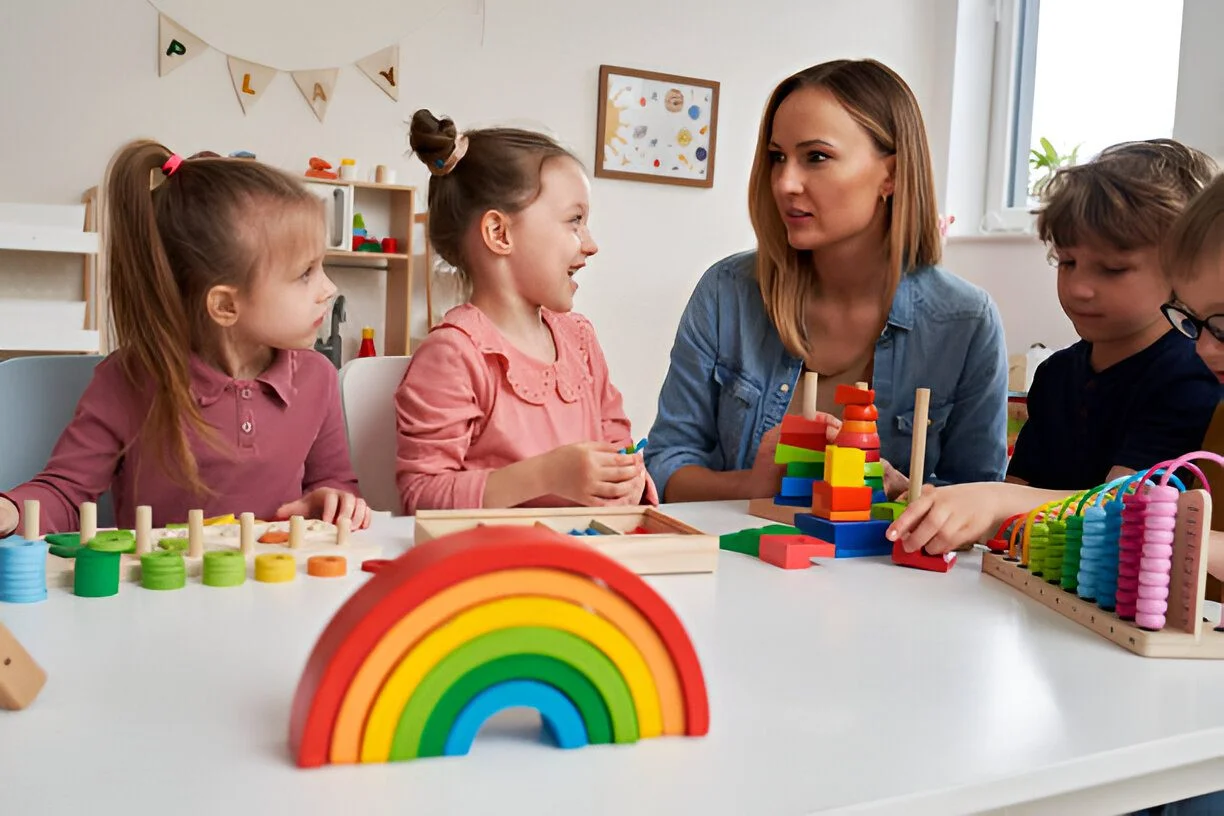
Choosing the right educational path for your child is one of the most important decisions a parent can make. At Rainbow Childhood Education Center, we’re often asked about the difference between Preschool and Kindergarten, especially by families navigating early childhood education for the first time.
While both settings are designed to support young learners in their development, Preschool and Kindergarten serve different purposes, follow different structures, and support children at slightly different stages of readiness. Understanding these similarities and differences can help you make informed decisions that align with your child’s needs and learning style.
Understanding the Basics: What Is Preschool?
Preschool is an early childhood education program typically designed for children aged 2.5 to 5. It provides a foundation for later learning by focusing on social, emotional, cognitive, and motor development through play-based experiences.
Preschool is often the first structured educational setting a child will experience outside the home. Its primary goal is to help children develop the foundational skills required for school readiness, including independence, communication, and basic academic concepts.
Key Features of Preschool:
- Age Group: Generally ages 2.5 to 5
- Focus: Social-emotional growth, early literacy and numeracy, sensory play, and motor skills
- Curriculum: Play-based and exploratory, often centered around themes and creative projects
- Schedule: Often part-time or flexible, though full-day options are available
- Classroom Structure: Small teacher-to-student ratios, nurturing environment, and lots of free play
Understanding the Basics: What Is Kindergarten?
Kindergarten is typically a more structured program for children aged 5 to 6. In most school systems, it serves as the bridge between preschool and first grade, focusing more on formal academic preparation, while still incorporating elements of play and creativity.
While the goals of kindergarten include continued social-emotional development, there is a noticeable shift toward structured learning and academic expectations.
Key Features of Kindergarten:
- Age Group: Generally age 5 or turning 5 by a specific cutoff date
- Focus: Academic preparation, basic literacy and math, structured routines, and school readiness
- Curriculum: More structured with daily goals, academic benchmarks, and classroom expectations
- Schedule: Usually full-day, Monday through Friday
- Classroom Structure: Larger groups with more formal instruction, including assessments and report cards
Preschool vs. Kindergarten: Key Differences
Although preschool and kindergarten have overlapping goals, particularly around supporting healthy child development, several important distinctions exist. Let’s take a closer look at the most significant differences.
1. Age and Developmental Readiness
Preschool is designed for younger children who are often still mastering basic life skills like toilet training, sharing, or self-regulation. Conversely, kindergarten assumes a level of maturity and readiness for a more academic, full-day program.
In summary:
Preschool: Ages 2.5–5, focus on foundational skills
Kindergarten: Age 5–6, focus on academic preparedness
2. Curriculum Structure
Preschool uses a play-based curriculum, integrating music, movement, storytelling, and sensory exploration. Kindergarten curriculum introduces more formal learning, with activities centered around reading, writing, and early math.
Preschool: Learning through play, open-ended exploration
Kindergarten: Structured learning blocks, lessons, and assessments
3. Daily Routine
Preschool schedules include large blocks of free play, creative art time, and flexible transitions. Kindergarten follows a more predictable routine, with time slots dedicated to literacy, math, science, and even physical education or technology, depending on the program.
Preschool routines: Flexible, with built-in rest and transitions
Kindergarten routines: More structured, with an emphasis on time management
4. Teacher Expectations
In preschool, teachers focus heavily on modeling behavior, conflict resolution, and nurturing independence. In kindergarten, teachers expect children to follow directions more independently, complete tasks on their own, and begin to develop self-discipline.
Preschool: Teachers guide and assist frequently
Kindergarten: Students are expected to follow classroom rules and complete assignments with less support
Preschool vs Kindergarten: Similarities
Despite the differences, preschool and kindergarten also share several similarities. Both are valuable stages in a child’s development and offer benefits beyond academic preparation.
1. Emphasis on Social-Emotional Learning
Social skills such as cooperation, empathy, and conflict resolution are central in preschool and kindergarten. Children continue learning to express themselves, build friendships, and navigate social environments.
2. Development of Independence
Whether in preschool or kindergarten, children are encouraged to try things independently of putting on jackets to managing transitions between activities. These experiences help build confidence and responsibility.
3. Language and Communication
Both stages nurture language development, expanding vocabulary through stories, songs, conversations, and guided activities. Children are supported in expressing their needs and respectfully asking questions.
4. Early Academic Skills
Preschool introduces basic academic concepts like counting, letter recognition, and shape identification. Kindergarten builds on this foundation with more structured lessons that include phonics, simple arithmetic, and problem-solving.
How to Choose Between Preschool and Kindergarten
For many families, preschool is the natural step before kindergarten. However, depending on a child’s age, maturity, and needs, parents may wonder whether to enroll directly in kindergarten or extend their preschool experience.
Here are a few factors to consider:
- Is your child emotionally ready for a full-day program?
Some children thrive in preschool’s flexible structure before transitioning to kindergarten.
- Has your child mastered self-care skills like using the restroom, dressing themselves, and following instructions?
These are often prerequisites for success in kindergarten.
- Does your child show interest in learning letters, numbers, or books?
A curious learner may benefit from the academic challenges of kindergarten.
- Are there preschool programs, like Rainbow Childhood, that offer a bridge-to-kindergarten curriculum?
Transitional programs can offer the best of both worlds.
The Rainbow Childhood Approach
At Rainbow Childhood Education Center, we recognize that every child develops at their own pace. Our preschool program is carefully designed to support early learners with hands-on, nurturing experiences that build social, emotional, and academic skills.
We offer enriched curriculum components for children preparing to enter kindergarten that introduce literacy, math, and critical thinking through playful learning. We aim to ensure every child feels confident, competent, and excited to continue their educational journey.
Furthermore, we also partner closely with parents to determine the best timing for the move to kindergarten, based on developmental milestones, not just age.
Final Thoughts
The discussion around Preschool vs. Kindergarten isn’t about which is better, it’s about understanding how each plays a unique role in your child’s early development. Preschool lays the foundation by building social-emotional skills, creativity, and basic concepts through guided play. Kindergarten builds on that foundation with more structured academic learning and school readiness expectations.
Both stages are vital, and choosing the right environment for your child depends on age, personality, and developmental readiness. At Rainbow Childhood, we’re here to support you every step of the way. Visit rainbowchildhood.com to learn more about our preschool programs or to schedule a tour with our team.